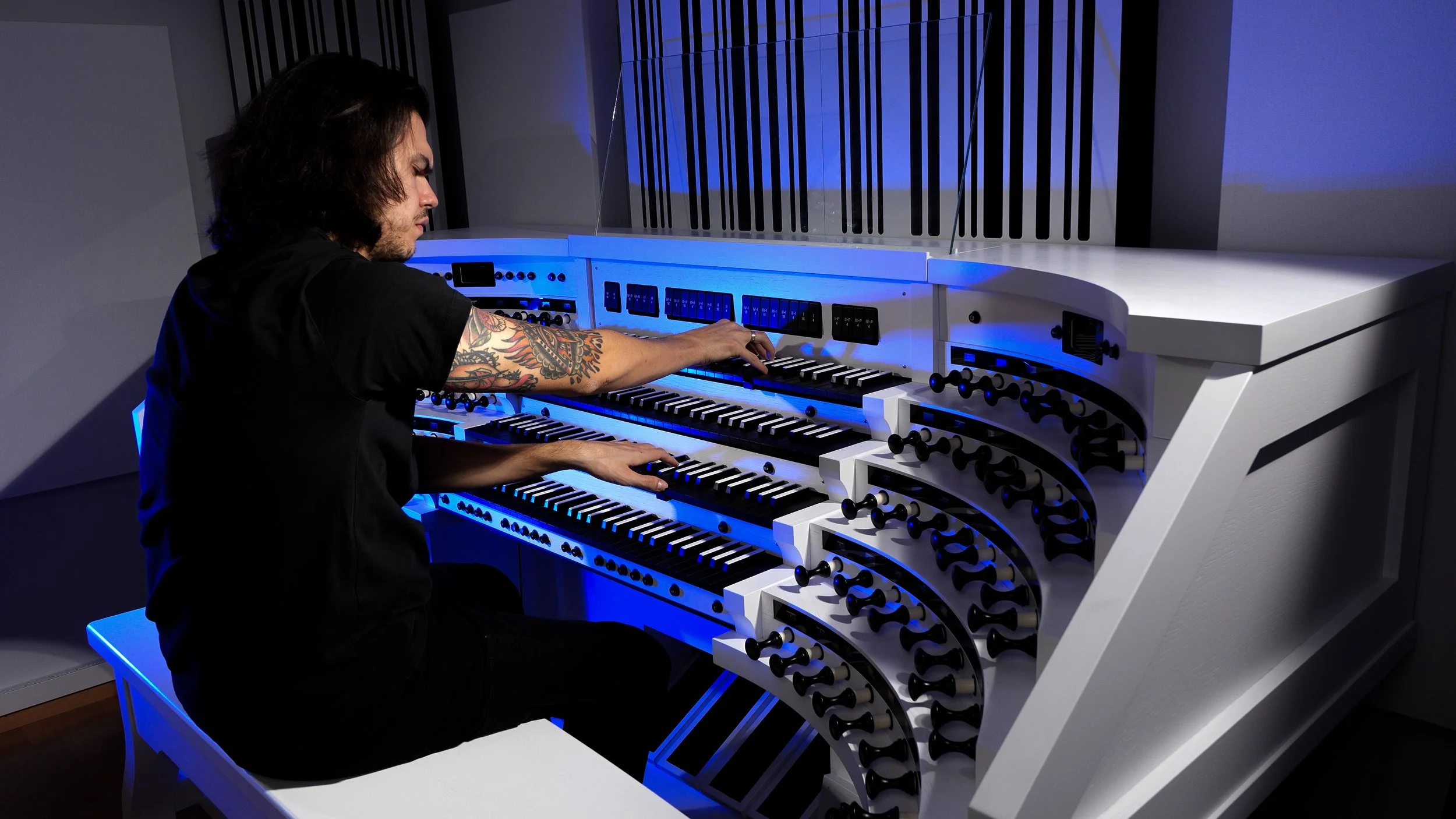
Giulio Lucciola (Rome, 1998) is a new-dimension organist who combines solid academic training with an independent and distinctive artistic outlook. He discovered the organ at the age of eight and immediately recognized it as the instrument that best reflected his musical personality, a path he has pursued with clarity and determination ever since. His education provided him with strong technical and stylistic foundations, while his personal exploration led him to approach tradition through a contemporary lens, free from schools and dogmas. Today, his work brings together technical mastery and a forward-looking perspective on the organ’s repertoire and expressive possibilities.
His formal organ training took shape between 2013 and 2017 at the Liceo Musicale Farnesina in Rome, where he studied with Luca Purchiaroni and Vincenzo Zito. He then continued at the Conservatorio Santa Cecilia in Rome from 2017 to 2020 with Alessandro Licata and Alberto Pavoni, completing the Bachelor of Music in Organ Performance with the highest marks and honours.
In the summer of 2020 he moved to Switzerland to continue his musical education. He completed the Master of Arts in Organ Performance at the Conservatorio della Svizzera Italiana in Lugano in 2022, studying with Stefano Molardi, and later entered the Master in Kirchenmusik at the Hochschule Luzern, with a major in organ and a minor in choral conducting. In Lucerne he studied with Suzanne Z’Graggen (organ), Kay Johannsen (improvisation) and Stefan Albrecht (choral conducting). During this period he was co-awarded the 1st Prize of the Alois Koch Competition, a distinction recognising his dedication and achievements as a student. This stage gave him a comprehensive understanding of the church musician’s role, from liturgical practice to the responsibilities connected with leading and shaping the musical life of a parish, and prepared him for both concert activity and professional work in the field of sacred music.
Alongside his academic work he has taken part in numerous masterclasses with major international organists. Encounters with Jean Guillou, Jean-Baptiste Monnot, Olivier Penin, David Briggs, Daniel Cook, Ralph Gustafsson, Ludger Lohmann and Lorenzo Ghielmi have played an important role in widening his artistic perspective and refining his interpretative approach.
His artistic focus is centred above all on the French Romantic and twentieth-century repertoire, which forms the core of his musical identity. The later nineteenth century represents the foundation of his work, with particular attention to the composers who shaped the French tradition, including Lefébure-Wély, Franck, Lemmens, Dubois, Guilmant, Gigout and Boëllmann. This aesthetic naturally extends towards the organ symphonism of Widor and Vierne, which occupies an essential place in the development of his musical language.
He also devotes significant attention to twentieth-century French music, maintaining a close engagement with the works of Dupré, Tournemire, Bonnet, Langlais, Litaize, Alain, Demessieux and Guillou. Within this landscape, the music of Olivier Messiaen holds a special place as his primary artistic reference, the world in which he most clearly recognises the essence of his own musical identity.
Although the French tradition remains the heart of his artistic profile, he approaches with ease the German repertoire of the nineteenth and twentieth centuries, often including in his programmes works by Liszt, Mendelssohn, Brahms and Hindemith. His repertoire also embraces the major organ masterpieces of Johann Sebastian Bach, which constitute an essential foundation for every organist, together with a sustained interest in the French Baroque. Through this wide and flexible approach, he maintains a versatile interpretative perspective, moving across different periods and musical languages while remaining firmly rooted in his principal aesthetic references.
Alongside his academic development he has progressively built a concert activity that has led him to perform in Italy, Switzerland and France. He is currently the organist of the Reformierte Kirche in Rafz, a town in the Zürcher Unterland region of the Canton of Zurich (Switzerland), where he lives.